Now accepting new clients in Texas
When Anxiety Won’t Let You Rest: A Therapist in Waco on What’s Really Going On
Hi friend,
Today I want to talk about anxiety. As a therapist in Waco who works mostly with women, it’s the thing I hear about most. It’s also the thing most often misnamed.
Women come into my office saying some version of the same sentence. “I’m just an anxious person.” “I’ve always been like this.” “I think I just need to manage it better.” Underneath those words, almost always, is a quieter one: I’m tired. I am so, so tired.
If that’s where you are right now, I want to offer a different frame. Not because the old one is wrong. Because there might be a more honest one.
Anxiety Isn’t a Personality Trait. It’s a Signal.
First, let me say this gently but clearly. Anxiety is not who you are. It’s something your nervous system is doing.
That sounds like a small distinction. However, it changes everything about how we work with it.
When we treat anxiety as a personality trait, we treat it like the weather. Something to endure. Something to be braver about. Something to white-knuckle through with deep breaths and the occasional journal entry.
When we treat it as a signal, however, we get curious. We ask: what is my body trying to tell me? What is it protecting me from? What has it been carrying?
Almost always, the answer is more interesting than “I just have anxiety.”
What Anxiety Often Actually Is
In my work with women, especially those navigating bariatric surgery, postpartum, or disordered eating, what gets labeled “anxiety” is frequently one of these things in a trench coat:
A nervous system stuck in survival mode. Maybe you’ve spent years operating in fight-or-flight. A high-pressure job, a hard relationship, kids who needed everything. As a result, your nervous system has learned that “on” is the default. The racing thoughts at 2 a.m. aren’t a character flaw. They’re a body that doesn’t believe it’s safe to power down.
Unprocessed grief or stress. The body keeps the score, as the saying goes. Big things you didn’t have time to feel don’t disappear. Instead, they wait. And often, they wait in the body, dressed up as anxiety.
Hypervigilance from old patterns. Perhaps you grew up reading the room constantly. Whose mood was where. What version of you was safe today. As a result, your nervous system became a finely tuned threat-scanner. That instrument doesn’t turn off just because you’re now a grown woman with your own keys.
A body asking for something it isn’t getting. Sometimes anxiety is the loudest way your body knows how to say I’m hungry. Or I’m exhausted. Or I haven’t been outside today. The need is real. However, the diagnosis is misleading.
The cost of being competent. Many of the women I work with are extraordinarily competent. They run households, careers, families, recoveries, all of it. Over time, they’ve learned that the cost of being held together is a low-grade hum of dread that never quite turns off.
What Doesn’t Usually Work (Even Though We Keep Trying)
Now I want to be honest about something else. The standard advice for anxiety often misses the point.
Deep breathing is a tool. However, it is not a treatment plan. Affirmations are nice. Still, they will not undo fifteen years of your nervous system learning that vigilance keeps you alive. Telling yourself to “just relax” works about as well as telling a fire alarm to be quieter.
What actually helps is slower, deeper work. Usually, it involves:
- Getting to know your nervous system instead of fighting it
- Naming the things you’ve been carrying without room to feel them
- Building real safety in your body, not just talking about safety in your head
- Looking at the patterns running quietly in the background
- Letting someone witness all of it without flinching or trying to fix you
That last one matters more than people realize. In fact, a lot of anxiety doesn’t loosen until another human being can stay with it.
How I Work With Anxiety
My approach is trauma-informed and nervous-system-focused. In other words, we don’t just talk about your thoughts. We pay attention to your body. We slow down enough that real change has room to happen.
I don’t believe in white-knuckling. Also, I don’t believe in shaming you for the ways you’ve coped. Your anxiety isn’t a flaw to be corrected. Instead, it’s information about your history, your body, and what your system has been quietly asking for.
The women I work with don’t leave therapy “cured” in some Instagram-graphic sense. However, they leave with a fundamentally different relationship to anxiety. They sleep better. They take up more room. They notice the hum of dread and recognize it as a message, not a verdict. As a result, they get tired less easily.
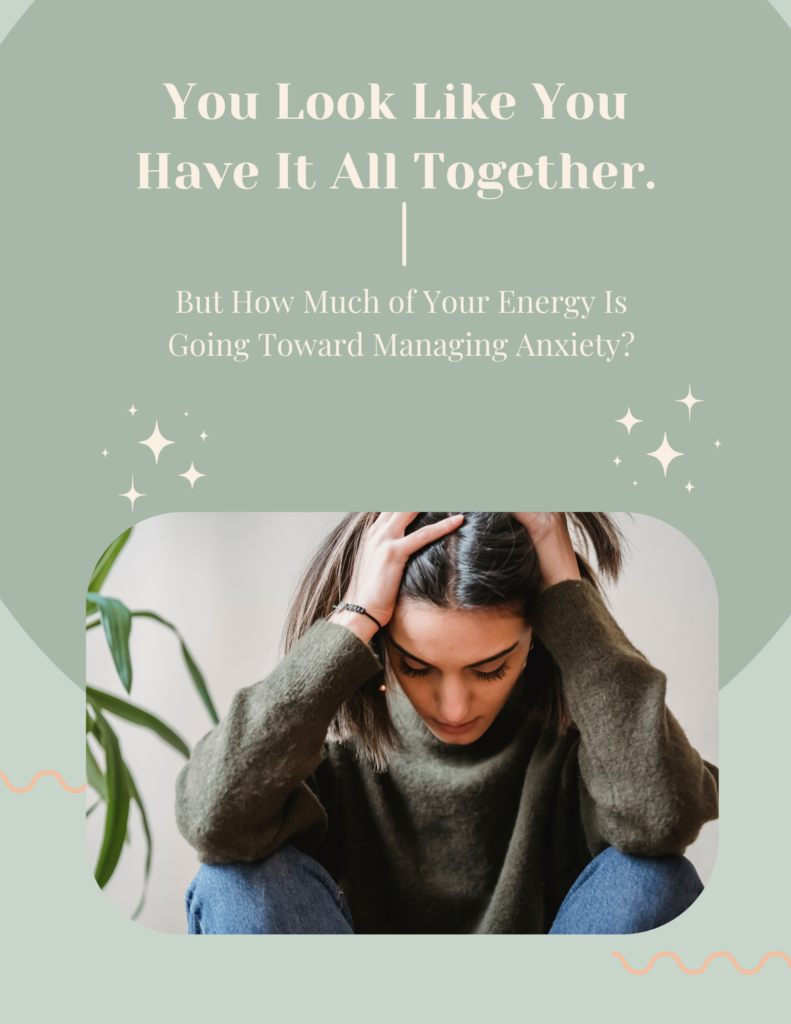
Curious if this is you? Use my free assessment to see where you are here.
If You’re Ready (or Almost Ready)
The women I work with don’t leave therapy “cured” in some Instagram-graphic sense. However, they leave with a fundamentally different relationship to anxiety. They sleep better. They take up more room. They notice the hum of dread and recognize it as a message, not a verdict. As a result, they get tired less easily.
If you’ve been carrying anxiety for years and you’re starting to suspect it might not just be “how you are” I’d love to talk.
I offer therapy for women across Texas virtually, and starting June 1st, in person at the Lake Air Drive office here in Waco. Consultation calls are free, 15 minutes, and you do not have to know what you want to say before you book one. You just have to be tired enough of the way things are.
Most of the women I work with reach out on what they later describe as “a random Tuesday I just couldn’t anymore.” There’s no perfect moment. If today is your random Tuesday, I’m here.
Not ready for therapy? That’s okay. Sign up for my Between Sessions Newsletter for updates, support, and free resources.
With warmth,
Hannah
Check out my website here

Hannah Short, LCSW is a licensed therapist in Waco, TX and Board-Certified Bariatric Counselor. Rooted & Nourished Psychotherapy offers private-pay individual therapy for women navigating anxiety, bariatric surgery, postpartum, body image, and disordered eating — virtually across Texas and in person at the Lake Air Drive office.
Social
Nav
Therapy in Waco, Texas
Subscribe to Between Sessions
A monthly note for women in Waco and Central Texas who see themselves in these words — motherhood, body image, and the tender in-between.
